Elevation impacts the movement of pitches. This is part of the reason why pitchers get rocked at Coors field in Denver. Though this is a well-researched topic, I thought I would take a (brief) look, as well.
The problem is an interesting research task due to confounding variables. For example, we cannot simple takes the average curveball movement by stadium. Why? Because, say, pitchers for the Braves might be better on average and, consequently, their curveballs will have more movement. This would make pitches thrown at Truist field look too good.
Likewise, we have to control for whether a pitcher was having a good game or a bad game. That is, when a pitcher is performing well, they will likely have more movement on their pitches. What’s more, we need to control for individual-pitcher effects. If a certain pitcher throws a lot at a certain park, they might skew the aggregate results. More pressing, we should not compare pitch movement across players when our research question is about elevation. We should analyze individual-level effects across pitch types (e.g., how does the slider for XYZ player compare across elevations).
Therefore, the best design would be to look at individual pitcher’s pitch movements, controlling for performance, elevation, and pitch type. This is no small task, especially for the ingestion of all the relevant data. For that reason, I will only analyze pitch movement for one pitcher as a demonstration.
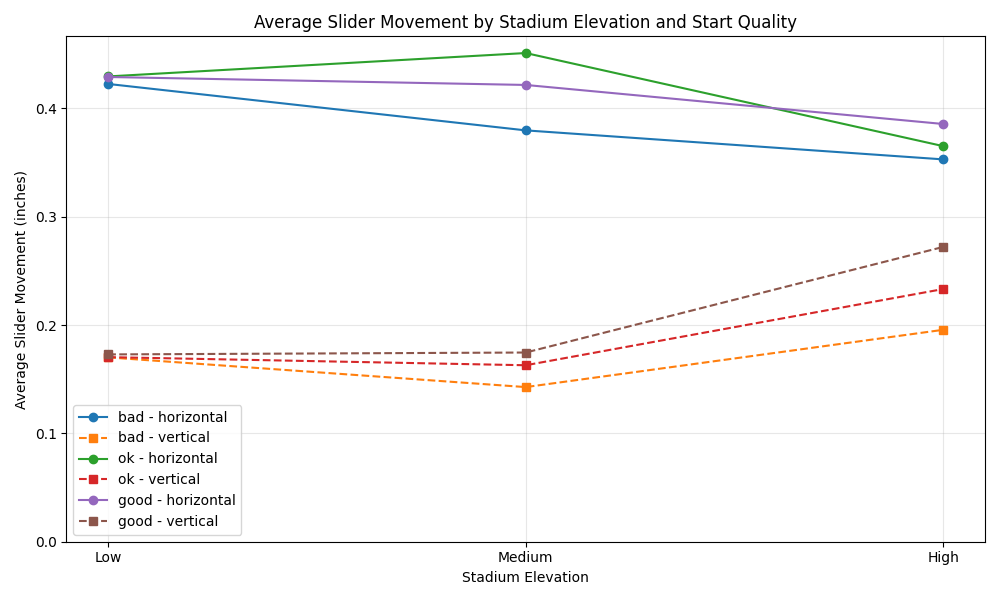
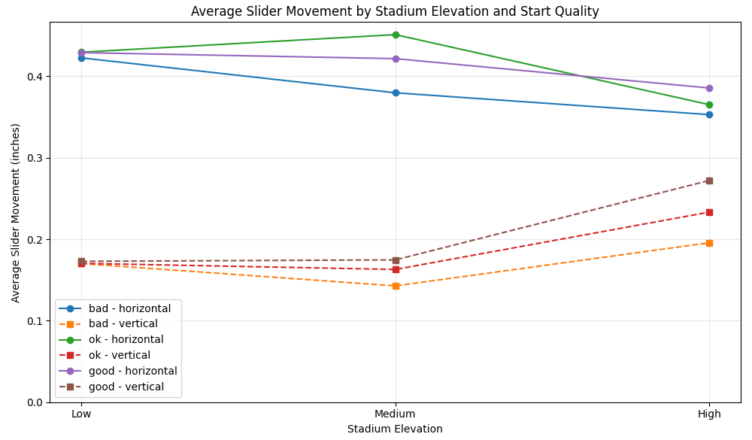
For the below, I pulled all pitching movement data for Garret Cole from pybaseball. I removed all starts under 50 pitches, segmented stadiums by elevation, and labeled starts as good / bad / ok based on strike ratio. We can adjust these parameters as desired. Again, the main idea is to show the structure and not necessarily a full-scale analysis.
Below are the results we get. Pretty interesting, right? We are able to notice variations in movements across elevations when controlling for all the discussed factors. I won’t dig into the details, but I am happy to see that our design found differentiation.
(To note, to learn more about the pitch movement data, please refer to this explainer. It can be a bit unintuitive).